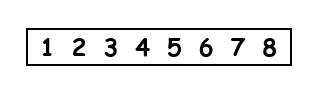
Problem You are given a collection of nuts of different size and corresponding bolts. You can choose any nut & any bolt together, from which you can determine whether the nut is larger than bolt, smaller than bolt or matches the bolt exactly. However there is no way to compare two nuts together or two bolts together. Suggest an algorithm to match each bolt to its matching nut.
Compute time complexity of your algorithm.
[Read More]
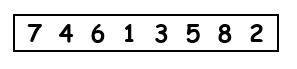
Sort a linked list using quick sort
Merge sort looks like a best choice for sorting the linked list.At a first appearance, merge sort may be a good selection since the middle element is required to subdivide the given list into 2 halves, but we can easily solve this problem by moving the nodes alternatively to 2 lists.
We have discussed the sorting options for linked list here. Here we will discuss about quick sort.
Another O(n log n) sort that you can implement on linked lists is a modification of quicksort.
[Read More]
What's the fastest algorithm for sorting a linked list?
Merge sort is the best choice. At a first appearance, merge sort may be a good selection since the middle element is required to subdivide the given list into 2 halves, but we can easily solve this problem by moving the nodes alternatively to 2 lists.
It is reasonable to expect that you cannot do any better than O(N log N) in running time, whenever we use comparison based sorts.
[Read More]
Sorting
A sorting algorithm is an algorithm that sorts the data into some order, say from ascending to descending.
The sorting problem
Input: Array of numbers , unsorted. Eg.
Output : Same numbers sorted in some order, say increasing order. Eg.
Classification of sorting algorithms
Sorting algorithm can be classified in various ways.
Comparison sorts vs non comparison sorts
Various sorts
Sorting Array of Three Kinds or The Dutch National Flag Problem OR three color sort
Question: given an array of three different kinds of value such as array(1, 2, 0, 2, 1) and array(a, b, a, c, b), write an algorithm to sort the array. For example, input array(1, 2, 0, 2, 1) becomes array(0, 1, 1, 2, 2) and input array(a, b, a, c, b) becomes array(a, a, b, b, c). This problem is also called three color sort.
Solution: the Dutch National Flag Algorithm sorts an array of red, blue, and white objects by separating them from each other based on their colors.
[Read More]
Sorting binary array - Array containing only 0 and 1 in one pass OR two color sort
in your Pseudocode, the if condition should be if …
RM - May 3, 2014
in your Pseudocode, the if condition should be if (low < high).
Thanks Rish. I have made the change a[low] > a[high] rather than low < low. :). Thanks for correcting me.
Sorting binary array - Array containing only 0 and 1 in one pass OR two color sort
Problem Sort a binary array - array containing 0s and 1s in 1 pass. This is also called two color sort.
Example Input - Binary unsorted array
A = {0,1,1,0,0,1};
Output - binary sorted array
B = {0,0,0,1,1,1}
Solution This is similar to quicksort partition algorithm. Though normal sorting takes O(n log n) time, but we have to just partition 0 from 1, and hence it should only take time of partitioning - O(n).
[Read More]
Quick sort
Hoore cisca discovered it in 1961.
Why quicksort?
Definitely a greatest hit algorithm Prevalent in practice O(n log n) time “on average” minimal extra memory needed (which gives it leverage over merge sort) The sorting problem
Input: Array of numbers , unsorted. Eg.
Output : Same numbers sorted in some order, say increasing order. Eg.
Quicksort helps us solving this problem.
What is quick sort?
[Read More]