Consider the tree: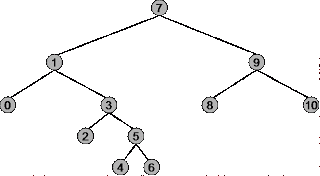
To traverse a binary tree in Postorder, following operations are carried-out (i) Traverse all the left external nodes starting with the left most subtree which is then followed by bubble-up all the internal nodes, (ii) Traverse the right subtree starting at the left external node which is then followed by bubble-up all the internal nodes, and (iii) Visit the root.
Therefore, the Postorder traversal of the above tree will outputs:
0, 2, 4, 6, 5, 3, 1, 8, 10, 9, 7
Recursive solution
postorder(Node \*root)
{
  if(root)
  {
    postorder(root->left);
    postorder(root->right);
    printf("Value : \[%d\]", root->value);
  }
}
Iterative solution
Iterative solution involves 2 stacks. So if we want to do the same thing iteratively; we just need to maintain 2 stacks child and parent. Following is the algorithm of this method:
- Push the root node to the child stack.
- while child stack is not empty
- Pop a node from the child stack, and push it to the parent stack.
- Push its left child followed by its right child to the child stack.
- end while
- Now the parent stack would have all the nodes ready to be traversed in post-order. Pop off the nodes from the parent stack one by one and you will have the post order traversal of the tree.
Here is the code for the same:
void postOrderTraversalIterativeTwoStacks(TreeNode \*root)
    {
        if (!root) return;
        stack<binarytree\*> child;
        stack<binarytree\*> parent;

        //Initialization
        child.push(root);

        while (!child.empty()) {
            BinaryTree \*curr = child.top();
            parent.push(curr);
            child.pop();
            if (curr->left)
                child.push(curr->left);
            if (curr->right)
                child.push(curr->right);
        }

        //Printing the post order traversal
       while (!parent.empty()) {
            cout << parent.top()->data << " ";
            parent.pop();
        }
    }
Dry running the code
Lets see a light example of how it works. Suppose we have a binary tree as shown below and we need to compute its post order traversal. It’s post order traversal will be
{A, C, E, D, B, H, I, G, F}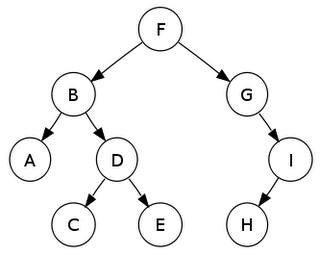
Here is how the stack grows:

Iterative solution using arrays
void iterativePostorder(node \*root) {
  struct   {
    node \*node;
    unsigned vleft :1;   // Visited left?
    unsigned vright :1;  // Visited right?
 }save\[100\];

int top = 0;
save\[top++\].node = root;

 while ( top != 0 )   {
/\* Move to the left subtree if present and not visited \*/
     if(root->left != NULL && !save\[top\].vleft)       {
          save\[top\].vleft = 1;
          save\[top++\].node = root;
          root = root->left;
         continue;
      }       /\* Move to the right subtree if present and not visited \*/
      if(root->right != NULL && !save\[top\].vright )       {
          save\[top\].vright = 1;
          save\[top++\].node = root;
          root = root->right;
          continue;
      }
      printf("\[%d\] ", root->value);
      /\* Clean up the stack \*/
      save\[top\].vleft = 0;
      save\[top\].vright = 0;
      /\* Move up \*/
     root = save\[--top\].node;
 }
}
http://leetcode.com/2010/10/binary-tree-post-order-traversal.html